


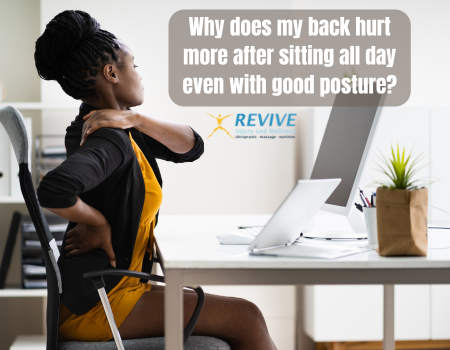
Good posture is supposed to fix back pain. That’s what everyone gets told. Sit up straight, screen at eye level, lumbar support in the right place, and the back stays comfortable. So when the back hurts anyway after a full day of doing everything correctly, the conclusion tends to be that something else must be wrong. Something structural. Something the ergonomic setup isn’t addressing.
The actual explanation is less mysterious and more frustrating. Good posture held completely still for eight hours is still eight hours of compression on a spine that was built to move, and the spine doesn’t care how correct the position is when nothing about it changes all day.
Spinal Compression
The discs between vertebrae are hydraulic. They distribute load and absorb shock through a fluid mechanism that depends on movement to work properly. Walking, standing, shifting weight, these things cycle the discs through loading and unloading in a way that keeps them functional and nourished. Sitting removes most of that cycling and concentrates spinal compression in a narrow range of positions for hours at a stretch.
The lumbar region takes the worst of it. The natural inward curve at the base of the spine tends to flatten during sustained sitting even when posture looks correct from the outside. That flattening changes how load moves through the lower back, the muscles holding everything in position have to compensate, and the discs that were supposed to be distributing force efficiently are instead bearing it in a compressed static position for the duration of the workday. The pain building through the afternoon isn’t a posture failure. It’s spinal compression doing what sustained compression does when nothing interrupts it.
Static Loading
There’s a biomechanics concept worth understanding here. Static loading is what happens when muscles hold a position without movement, a sustained contraction that accumulates fatigue differently than the kind of effort that actually feels like work. Sitting looks passive. The paraspinal muscles running along the spine don’t experience it that way. They’re in continuous low-level contraction for hours holding the torso upright, and that sustained effort produces fatigue that builds slowly enough to be invisible until mid-afternoon when it isn’t invisible anymore.
The hip flexors make it worse. They sit at the front of the hip and connect to the lumbar spine, and sustained sitting keeps them shortened. Shortened hip flexors pull on the pelvis in a way that increases compression on the lumbar vertebrae regardless of how the upper body is positioned. The posture can look right. The mechanics underneath it can still be working against the lower back because of what hours of sustained shortening does to the structures attached to the spine. This is why people who sit with textbook posture all day still end the day in pain. The problem isn’t the position. It’s the duration.
Micro-Movements
The thing that’s actually missing is micro-movements, the small continuous shifts in position the body makes naturally when it isn’t locked into a chair for hours. Walking involves constant subtle adjustments, weight shifting, joint angles changing, muscle activation patterns alternating rather than sustaining. None of that happens in a fixed seated position and the spine loses the hydraulic cycling that keeps it functional over time.
Getting up every thirty minutes isn’t a vague wellness suggestion. It’s the specific intervention the spine needs. Two minutes of walking reloads the lumbar discs through movement, gives the paraspinal muscles a break from sustained contraction, and restores enough hip flexor length to change the load distribution when sitting resumes. The back that was building toward a painful afternoon gets a reset that actually changes the trajectory of how the rest of the day feels.
The activity doesn’t matter much. Walking to another room, standing during a phone call, a short loop around the office. What matters is interrupting the compression and the static loading before they accumulate to the point of pain. A standing desk helps if it actually changes the position. It doesn’t help if it just substitutes one sustained static posture for another.
Chiropractic Solutions
A back that hurts progressively through a sitting day and feels better with movement is almost always a back with restricted joint mobility that makes sustained compression more problematic than it should be. Spinal joints that move freely distribute load and recover from compression efficiently. Joints that have developed restriction through years of accumulated static loading don’t, and the pain that builds through the day is what that difference feels like from the inside.
Chiropractic care works on the restriction directly rather than the symptom. Adjustments restore mobility to segments that lost it, which changes how the spine handles the compression that a desk job imposes every single day. Not to make sustained static sitting comfortable indefinitely. To restore the mechanics that make the spine more resilient to the loading it’s going to face regardless of how good the posture is.
Restored spinal mobility alongside consistent movement breaks changes both sides of the problem at once. The spine’s capacity to handle compression improves. The compression itself gets interrupted often enough that it doesn’t accumulate to the point of pain. One without the other addresses part of it. Both together is what actually holds.